 Excelrs
When not to use a model
Numbers and rows go through code. Expensive misses need a hard rule. A sentence never overrides the count.
Sandeep Jaiswal·3 November 2026 · 5 min read
A model is a good next-word machine. It is a poor cashier, a poor lock, and a poor source of a number you already have in a table.
This post is when to skip the model, what to use instead, and a short list you can keep next to a new idea.
Skip it when you already have the answer
If the rule is “36 of 40 is 90%,” do the divide in code. Do not ask a model to compute it.
If the user id is in the database, read the row. Do not ask a model who the user is.
If the form has three required fields, validate in code. A model that “understands” the form will still miss a blank on a bad day.
If a
ifcan decide it, do not spend a token on it.
Skip it when a miss is expensive
Money, marks, medical advice, passwords, who is allowed in.
A wrong Thursday in a study helper is annoying. A wrong refund is a fight. A model in that path needs a human or it should not be there.
If you cannot name who checks the answer before it ships, do not put the model on that step.
Retrieval plus a cite is still not a cashier. The cite can be right and the sum can be wrong. Sum in code.
Skip it when you cannot check
Open chat with no file and no schema is a demo. Ship it as a demo.
If you cannot write five cases, you cannot tell a miss from a pass. Build the cases first. If they are all “write something nice,” you do not have a product yet.
A judge model with no field is another skip. Two models agreeing is not a check.
Walk through once
Someone wants “an AI that tells students if they can sit the exam.”
You have attendance in a table: present count, total count, rule 75%.
Wrong build: send the table to a model, ask for a yes.
Right build: present / total >= 0.75 in code. Show the numbers. If you still want a sentence, the model may phrase “you are at 90%, the rule is 75%.” It does not decide.
Add a bait: a row with 20 of 40. Code says no. If a model in the path says “maybe if you talk to the HOD,” you let a sentence override the rule. Delete that path.
The useful model, if any, is later: “explain this rule in two lines from the handbook chunk.” That is RAG plus a cite. The yes/no already happened.
What good looks like
The exam seat decision is a boolean from two numbers. A test can assert it. No model is in that function.
The sentence under the boolean, if it exists, cites a chunk. A test can fail the sentence without flipping the boolean.
A payment path has no model, or a model that cannot move money.
A new idea gets a row on the skip list before it gets a prompt.
“We’ll add AI later” is fine
Ship the calculator. Put a note: sentence later, maybe.
What is not fine: a chat box on the exam page that can say yes when the count says no. Users will believe the chat. The if becomes theatre.
If you need a placeholder, show the numbers and a static line from the handbook. That is already useful. You can add RAG when the cite path exists.
Do not leave an empty “Ask AI” that hits a general model with the student record. That is a skip you failed.
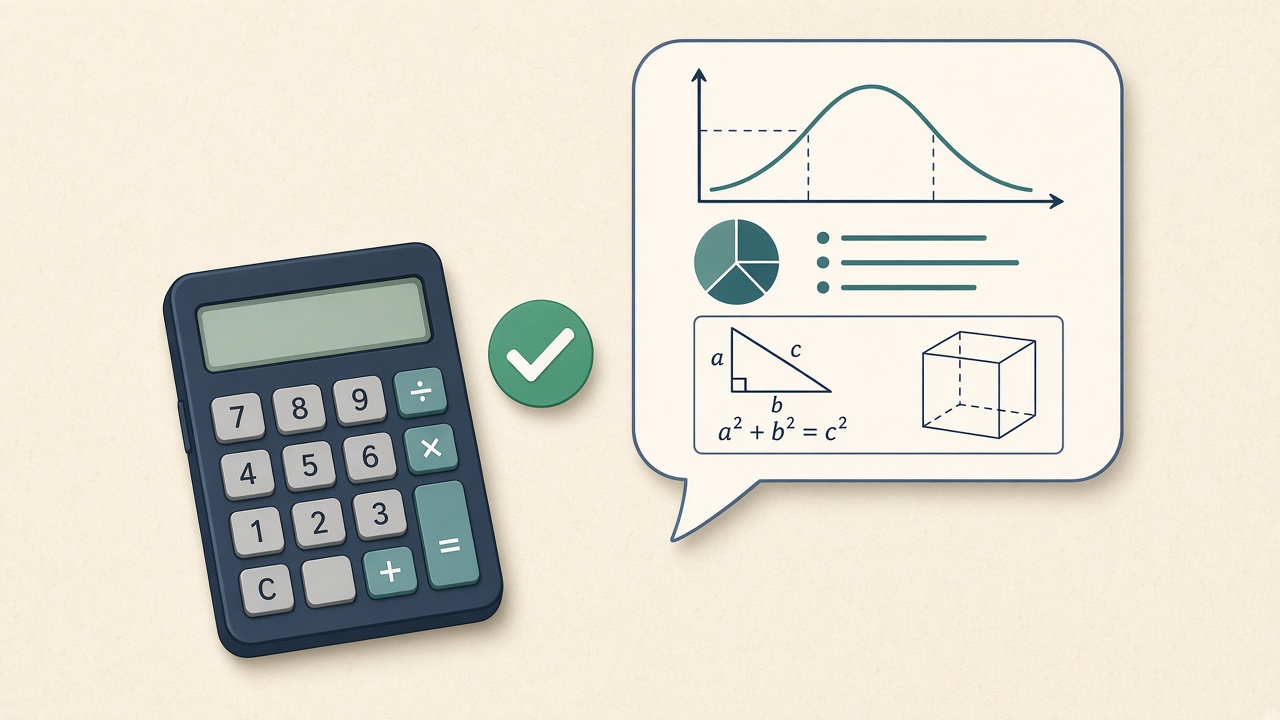
The tick is on the count. The sentence is optional.
A short list
| Idea | Model? | Use |
|---|---|---|
| Percentage from two numbers | No | Code |
| Fetch the student’s row | No | Database |
| Phrase a cited rule | Yes, after retrieve | RAG + cite |
| Approve a payment | No | Human or ledger rules |
| Guess a fee not in the file | No | Refuse |
| Sort by date | No | Code |
| Turn a question into a search line | Often yes | Small model + schema |
If a row says no, do not add a model “to make it smarter.”
Common mistakes
A model in front of a calculator. You will debug poetry.
A model as the only gate. Someone will jailbreak a refund.
Explaining a skip as “we will add AI later.” Later is fine. Do not leave a hole that looks like a feature.
Checking the demo with friends, not cases. Friends are kind.
Using a model because the slide said AI. The slide is not a spec.
Practise
- Write the decision in one line.
- If it is a number or a row, write the
if. - Only then decide if a sentence needs a model.
- Name the miss you cannot afford.
- If you cannot name a check, do not ship the model on that step.
Most rows should stay skip. That is a clear product, not a timid one.
Checklist
- Numbers and rows go through code.
- Expensive misses have a human or a hard rule.
- No check means no model in the path.
- A sentence never overrides a calculated yes/no.
- You have a skip list for the next idea.
The next step is an if for the percentage, not a prompt that tries to be one.